

Description
Ten days and nine nights: this is the only trip we offer from Marrakech that reaches northern Morocco and Chefchaouen. The loop is a complete one: Marrakech, Casablanca, Rabat, the blue city, Volubilis and Meknes, Fes, the Sahara at Merzouga and the return by Ouarzazate. It can end at Marrakech airport or at Casablanca, three hours away by road.
Two full days are entrusted to authorised local guides: the Marrakech medina on day two, with the Koutoubia, the Bahia, the Saadian tombs and the Ben Youssef madrasa, and Fes el-Bali on day six, between the Bou Inania madrasa, the Al-Qaraouiyine university and the Chouara tanneries. In between are the Hassan II mosque in Casablanca, the Hassan Tower and the Kasbah of the Udayas in Rabat, the Roman mosaics of Volubilis and the blue façades of Chefchaouen.
The desert comes only at the end of day seven, the longest of the trip at about seven hours by way of Ifrane, the Azrou cedar forest and the Ziz Valley: a single night in the camp, with camels and sunset over the Erg Chebbi. Departures are fixed on Mondays and Fridays, the price is €970 per person sharing a double room and the group is seventeen at most. Choose it if you want the whole country, not only the south.
| Day | Departure from | Arrival |
|---|---|---|
| 1st | Airport | Marrakech |
| 2nd | Marrakech | Marrakech |
| 3rd | Marrakech | Casablanca |
| 4th | Casablanca | Chefchaouen |
| 5th | Chefchaouen | Fes |
| 6th | Fes | Fes |
| 7th | Fes | Merzouga (desert) |
| 8th | Merzouga | Ouarzazate |
| 9th | Ouarzazate | Marrakech |
| 10th | Marrakech | Airport (Marrakech or Casablanca) |
Tour itinerary
Day 1
Marrakech airport > Marrakech:
The group tour begins in Marrakech, the red city at the foot of the High Atlas. One of our drivers, Omar or a colleague of his, meets you at Marrakech Menara airport with the agency sign and takes you to your hotel or riad; if you arrive by train or are already in town, the pick-up is at your accommodation. Nothing is scheduled for the rest of the day: the afternoon is free to rest, take a first walk through the lanes of the medina and get used to the Moroccan pace.
Towards sunset it is well worth heading to Jemaa el-Fna square, listed by UNESCO as part of the oral and intangible heritage of humanity. As evening falls the food stalls appear, along with the orange-juice sellers, the Gnawa musicians and the storytellers, and from one of the terraces overlooking the square you can see the floodlit minaret of the Koutoubia. In the evening you meet your driver and your travelling companions for a short briefing on the days ahead. Overnight in Marrakech.
Day 2
Marrakech > guided city visit:
After breakfast a licensed local guide joins the group for a full day inside the medina of Marrakech, itself a UNESCO World Heritage site. You start at the Koutoubia, the twelfth-century mosque whose 77-metre minaret is the landmark of the whole city, and continue to the Bahia Palace, with its marble courtyards, painted cedar ceilings and gardens of bitter orange trees.
The visit goes on to the Saadian Tombs, rediscovered only in 1917 and decorated with carved stucco and columns of Carrara marble, and to the Ben Youssef Madrasa, the old Quranic school whose courtyard is covered in zellige tilework. In the afternoon you walk through the souks: the dyers' quarter, the blacksmiths, the basket makers and the slipper sellers, right through to the spice square. Anyone who wishes can add a visit to the Majorelle Garden or the Yves Saint Laurent museum, both in the modern district of Guéliz. Second night in Marrakech.
Day 3
Marrakech > Settat > Casablanca:
We leave Marrakech after breakfast and take the motorway north, crossing the great cereal plains of Settat and the Chaouia. It is about three hours' drive, with one stop along the way, and by mid-morning we reach Casablanca, Morocco's economic capital and its largest city, facing the Atlantic.
The highlight of the day is the Hassan II Mosque, built partly over the ocean and inaugurated in 1993. Its 210-metre minaret is one of the tallest in the world, and this is one of the very few mosques in Morocco that non-Muslims may enter, on guided visits at fixed times (the ticket is not included). We then drive along the Aïn Diab Corniche, the seafront of cafés and beach clubs, and through the colonial centre around Mohammed V Square, with its law courts and 1930s art deco buildings. There is also time for the Habous quarter, the "new medina" built in the 1920s, with its shops full of olives, pastries and books. Dinner is at your own arrangement; overnight in Casablanca.
Day 4
Casablanca > Rabat > Chefchaouen:
An early start north along the Atlantic coast. The first stop is Rabat, the capital of Morocco and an imperial city: here we visit the Hassan Tower, the unfinished twelfth-century minaret that rises above the columns of a mosque that was never completed, and the Mausoleum of Mohammed V. A short walk away is the Kasbah of the Udayas, a fortified citadel of white and blue houses looking out over the mouth of the Bou Regreg river. If you would like to read more, see our article on the imperial cities of Morocco.
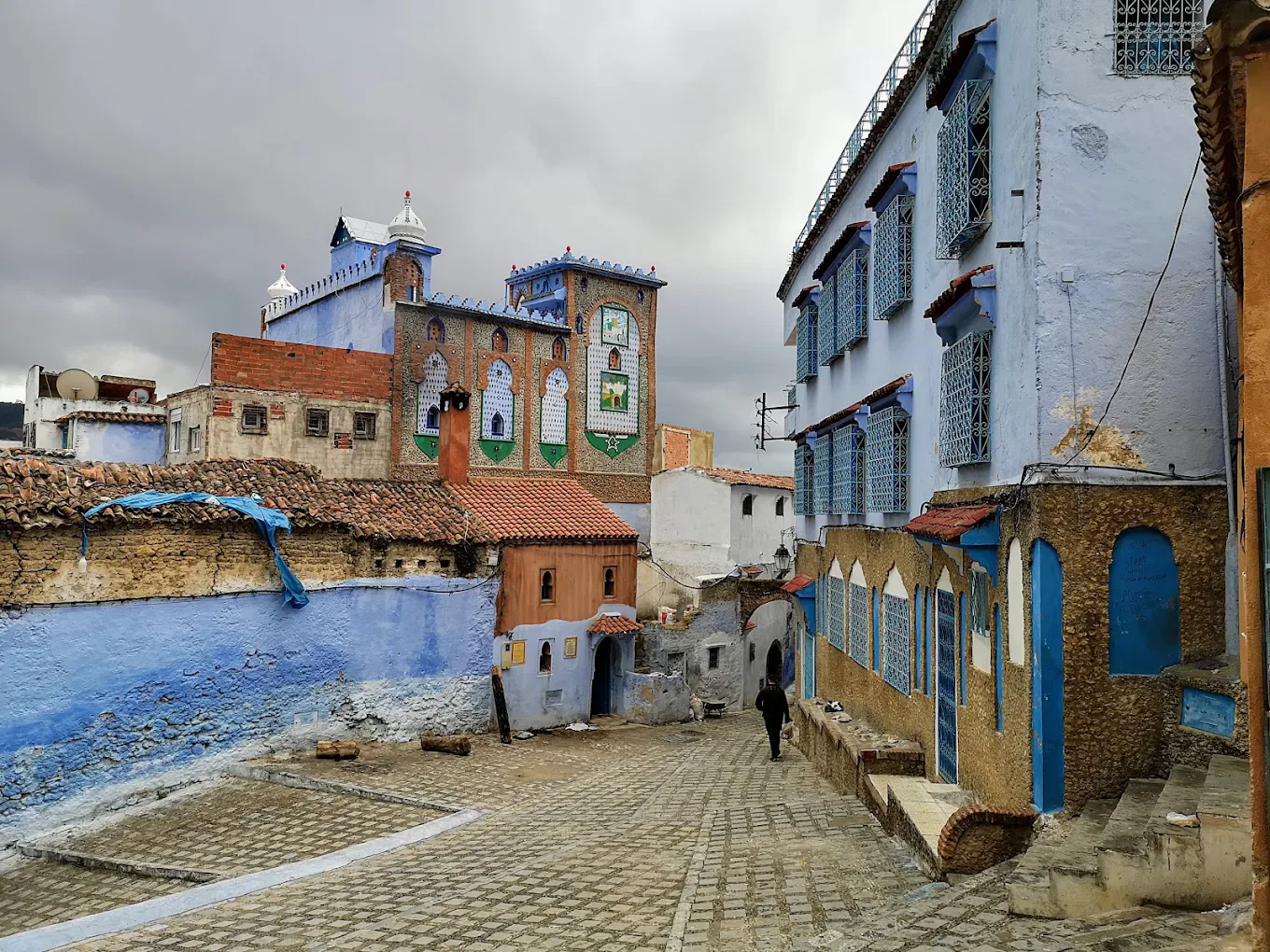
In the afternoon we head inland through the olive-covered hills of the Rif to reach Chefchaouen, the famous "blue town" founded in 1471. Walking through the medina you will find staircases, doors and façades painted in every shade of blue, Uta el-Hammam square with its mosque and octagonal minaret, and the eighteenth-century kasbah. It is a short stay but an unforgettable one: the late afternoon light on the blue walls is the best moment for photographs. Overnight in Chefchaouen.
Day 5
Chefchaouen > Volubilis > Meknes > Fes:
There is time in the morning to climb to the Spanish Mosque on the hill facing the medina, from where the whole of Chefchaouen can be seen set between the two peaks of the Rif. We then drive south through the fields and villages of the Ouezzane region.
The main stop of the day is the archaeological site of Volubilis, a UNESCO World Heritage site and the most important Roman city in Morocco, founded in the third century BC and made prosperous by olive oil and grain. You will walk among the Capitol, the basilica, the Arch of Caracalla and, above all, the mosaics still in place in the patrician houses, with scenes of Orpheus, Bacchus and the labours of Hercules. Just beyond stands the white village of Moulay Idriss Zerhoun, perched on its sacred hill. Before reaching our destination we stop in Meknes, the imperial city of Sultan Moulay Ismail, in front of the monumental Bab Mansour gate. We arrive in Fes in the evening for the overnight stay.
Day 6
Fes > guided visit of the medina:
A full day devoted to Fes, the oldest of the imperial cities and the spiritual capital of Morocco, in the company of a licensed local guide. You enter the medina of Fes el-Bali through the blue gate of Bab Boujloud and plunge into a maze of some nine thousand lanes, where goods still travel on muleback.
During the visit you will see the fourteenth-century Bou Inania Madrasa, with its courtyard of marble, cedar and carved stucco, and pass the Al-Qaraouiyine University, founded in 859 by Fatima al-Fihri and considered the oldest university still in operation anywhere in the world. There is a stop at the Nejjarine fountain, in the carpenters' square, and of course at the famous Chouara tanneries, where hides are still worked in vats of lime and natural dyes: the terraces above offer the best-known view in Fes. In the afternoon we go up to Borj Nord or the Merinid tombs for the panorama over the rooftops of the medina, and pass the golden gates of the Royal Palace in the Fes el-Jdid district. Second night in Fes.
Day 7
Fes > Ifrane > Azrou > Midelt > Merzouga:
This is the longest day of the trip, around seven hours on the road, but also one of the most varied. We cross the Middle Atlas and stop at Ifrane, the town of steep pitched roofs nicknamed "the little Switzerland of Morocco", then in the cedar forest of Azrou, home to wild Barbary macaques. We continue to Midelt, between the Middle and the High Atlas, where we have lunch at the restaurant we have always stopped at, with tagine, grilled meat (BBQ) and mint tea. We then drop down the spectacular Ziz valley, a green ribbon of palm trees set between red cliffs, as far as Erfoud and Rissani.
In the late afternoon we reach Merzouga, at the foot of the Erg Chebbi dunes, which rise up to 150 metres. Here we leave the large bags and set off on the camel trek towards the camp: about an hour in the saddle up to a high dune, where you watch the sunset over the Sahara. At the camp, our own Camel Trips Camp, you are welcomed with Berber tea, followed by a Moroccan dinner served under the stars and drumming around the fire. Night in a desert camp.
Day 8
Merzouga > Todra Gorge > Dades Valley > Ouarzazate:
Anyone who wishes can get up early for sunrise over the dunes, the moment when the sand turns from pink to orange. After breakfast at the camp we return to the village of Merzouga and set off west along the Road of a Thousand Kasbahs, stopping at Tinghir and its palm groves.
The morning culminates in the Todra Gorge, where sheer limestone walls up to 300 metres high close in until there is barely room for the road and the stream: there is time to walk into the gorge and to have a glass of tea in the shade. In the afternoon we cross the Dades Valley, famous for its "monkey fingers" rock formations and its mud-brick kasbahs, and then Kalaat M'Gouna, the valley of roses that produces Moroccan rose water. Shortly before arriving we skirt the great palm grove of Skoura. We reach Ouarzazate, the "gateway to the desert", home to the Taourirt Kasbah and the well-known film studios. Dinner is at your own arrangement; overnight in a hotel.
Day 9
Ouarzazate > Aït Ben Haddou > Tizi n'Tichka > Marrakech:
After breakfast it takes only thirty minutes to reach the ksar of Aït Ben Haddou, a UNESCO World Heritage site and the most famous image of southern Morocco: a fortified village of mud-brick houses clinging to the hillside, protected by walls and crenellated towers. Crossing the bed of the Ounila river you climb to the old granary at the top, where the view stretches over the valley and its palm groves. Gladiator, Lawrence of Arabia, Kingdom of Heaven and Game of Thrones were all filmed here.
We then take the road towards the High Atlas, climbing hairpin bends to the Tizi n'Tichka pass at 2,260 metres: the highest road pass in Morocco, with views over the Berber villages clinging to the mountainsides. On the way down there is the chance to stop at a women's argan oil cooperative. In the afternoon we return to Marrakech, where the last evening is free: you can go back to Jemaa el-Fna for dinner or treat yourself to a hammam. Overnight in Marrakech.
Day 10
Marrakech > Marrakech or Casablanca airport:
The last day is arranged around your return flight. If you fly out of Marrakech, you still have a few free hours after breakfast for some last shopping in the souks or a walk in the Menara gardens, and our driver takes you to Marrakech Menara airport in time for check-in.
If your flight leaves from Casablanca, we arrange a transfer to Mohammed V airport instead: this takes about three hours by road, so the departure from Marrakech has to be planned well in advance. Please tell us which option you need when you book, so that we can agree the time of the transfer together. Saying goodbye to your driver and your travelling companions brings the 10-day group tour from Marrakech to a close; if you would like to come back with family or friends, have a look at our other tours from Marrakech.
Book the 10-day group tour from Marrakech
The price of the 10-day group tour from Marrakech is €970 per person in a double room and includes the minibus with driver, accommodation with breakfast, the night in a Merzouga desert camp and the local guides in Fes and Marrakech.
Book nowNote: Departures are fixed every Monday and Friday, the group has a maximum of 17 travellers and the tour runs with a minimum of 2 participants.
Included
- Pick-up and drop-off at your hotel or riad in Marrakech, or an airport transfer where the itinerary requires it
- Transport in an air-conditioned minibus with an experienced local driver
- Accommodation in hotels and riads with breakfast
- One night in a desert camp at Merzouga with dinner, breakfast and Berber music
- Camel trek at sunset on the Merzouga dunes
- Licensed local guides for the city visits of Fes and Marrakech
Not included
- Flights
- Lunches
- Drinks
- Entrance fees to monuments
- Tips
- Personal expenses
- Travel insurance
- Single-room supplement
Frequently asked questions
Which days does the tour leave and how is the booking confirmed?
The tour leaves Marrakech every Monday and every Friday, all year round. Your booking is confirmed with a 10% deposit, and the balance is paid on arrival in Morocco. We recommend writing to us a few weeks ahead, as the seats on the minibus are limited.
How many people are there in the group?
This is a small group tour, with a maximum of 17 travellers sharing the same air-conditioned minibus and the same driver. The other passengers book individually, just as you do, so you will meet couples, groups of friends and solo travellers of different ages. The tour runs with a minimum of 2 participants.
I am travelling on my own. Can I join the group?
Yes, this group tour is designed with solo travellers in mind too. The price of €970 is per person in a double room, so the room is shared with another traveller of the same sex. If you prefer a room of your own, the single-room supplement is not included and should be requested when you book.
Do children pay less?
Yes, children under 10 pay 5% less than the per-person price. The itinerary does include a few long driving days, but the stages are broken up with regular stops, and the night in the desert camp with the camel trek is usually the highlight for younger travellers. Tell us the children's ages when you write, so that we can arrange the seats and the rooms.
Where are we picked up and how does the last day work?
On day 1 we meet you at Marrakech Menara airport or, if you are already in the city, directly at your hotel or riad. On day 10 you have two options: a transfer to Marrakech airport for your flight home, or a transfer to Casablanca airport, which takes about three hours by road. Let us know which you prefer when you book, so that we can set the departure time.
What do I need for the night in the desert and how much luggage can I bring?
For the night in Merzouga you only need a small backpack with your overnight essentials, as the suitcases stay in the minibus or at the hotel. Bring layers, because desert nights are cool even in summer, plus a scarf, comfortable shoes, sunscreen and a torch. Each traveller may bring one suitcase and one piece of hand luggage.
If we travel in August, is the desert night still spent in a tent?
In August the Sahara is scorching and sandstorms can arrive. If the night planned among the dunes is not workable, the group sleeps in a hotel in Merzouga instead of the camp.
What our travellers say
Excellent
Based on 64 reviews on Tripadvisor
Reviews of our 10-day tour from Marrakech are written by real travellers and verified by Tripadvisor. Read about their experiences on our private tours in Morocco.
Read all reviews