

Description
Eight group days arranged in a deliberate order: the Sahara first, Marrakech afterwards. Day one exists only to get you here — we meet you at Marrakech-Menara airport and take you to your hotel — and the full day in the city, with an authorised local guide, comes on day seven, when you no longer have to set off again the next morning. Fixed departures on Tuesdays and Saturdays, €660 per person sharing a double room, seventeen travellers at most.
From day two the road runs south over the Tizi n’Tichka pass, past Aït Ben Haddou and into the Dades gorges, then the Todra and the camel ride into Merzouga. Day four stays among the dunes: nomads, Khamlia, Dayet Srji, kohl mines, two nights in the same tent. The return runs by Rissani, Alnif, the Jbel Saghro and the Draa Valley, with a night in Ouarzazate, and day six is deliberately short so you reach Marrakech with energy to spare.
That day covers the Koutoubia, the Bahia Palace, the Saadian tombs, El Badi, the Ben Youssef madrasa and the souks, and ends at sunset in Jemaa el-Fna. Day eight is the airport transfer, afternoon flights included. Pick it if you fly into Marrakech and want the desert straight away, with the city as the finale.
| Day | Departure from | Arrival |
|---|---|---|
| 1st | Marrakech airport | Marrakech |
| 2nd | Marrakech | Dades |
| 3rd | Dades | Merzouga (desert) |
| 4th | Merzouga | Merzouga |
| 5th | Merzouga | Ouarzazate |
| 6th | Ouarzazate | Marrakech |
| 7th | Marrakech | Marrakech |
| 8th | Marrakech | Marrakech airport |
Tour itinerary
Day 1
Marrakech airport > Marrakech:
This group tour is designed for travellers who want to reach the Sahara quickly and keep the city for the end. The first day is purely about arriving: a member of our team meets you at Marrakech-Menara airport with a sign showing your name and takes you to the hotel or riad booked for the night. There are no visits scheduled and no timetable to keep, so you can recover from the journey and get your bearings.
If you land early, the afternoon is free for a first walk: from most hotel districts you can reach the Koutoubia on foot and look out over Jemaa el-Fna around sunset, when the juice stalls and food carts open and the square changes character. There is no need to see everything now — the full guided day in Marrakech comes on day 7, once you are back from the desert. In the evening the driver confirms the departure time for the following morning, usually around 8:00.
Day 2
Marrakech > Tizi n’Tichka > Aït Ben Haddou > Ouarzazate > Dades:
The journey proper begins early: the minibus collects every participant from their accommodation and leaves Marrakech heading south at 8:00. The road climbs straight into the High Atlas through a long series of hairpin bends up to the Tizi n’Tichka pass at 2,260 metres, where the viewpoint stop shows you the green valleys of the northern slope on one side and, on the other, the dry landscape that announces the south. The same driver stays with you for all 8 days — Ahmed, Omar or another of our team — and he knows this pass bend by bend.
Below the pass we turn off to the ksar of Aït Ben Haddou, a UNESCO World Heritage site: an entire fortified village of packed earth clinging to the hillside, where you climb through narrow lanes to the old granary at the top and look out over the Ounila valley. It was the set for films such as Gladiator and series such as Game of Thrones. After the lunch stop we continue to Ouarzazate, with the Taourirt kasbah and the film studios, and then along the Road of a Thousand Kasbahs through the palm groves of Skoura. We reach the Dades valley in the late afternoon, where you have dinner and spend the night in a hotel between the red walls of the gorge.
Day 3
Dades > Todra Gorge > Erfoud > Merzouga > desert:
After breakfast there is time for a short walk to the famous “monkey fingers”, the rock formations that make the Dades instantly recognisable, and for the scenic hairpins that climb the valley. We then take the road east to Tinghir and its very long palm grove before arriving at the Todra Gorge: a canyon where the limestone walls narrow to a few dozen metres and rise more than 300, with the stream running along the bottom. Here you walk a stretch on foot, in the shade, before setting off again.
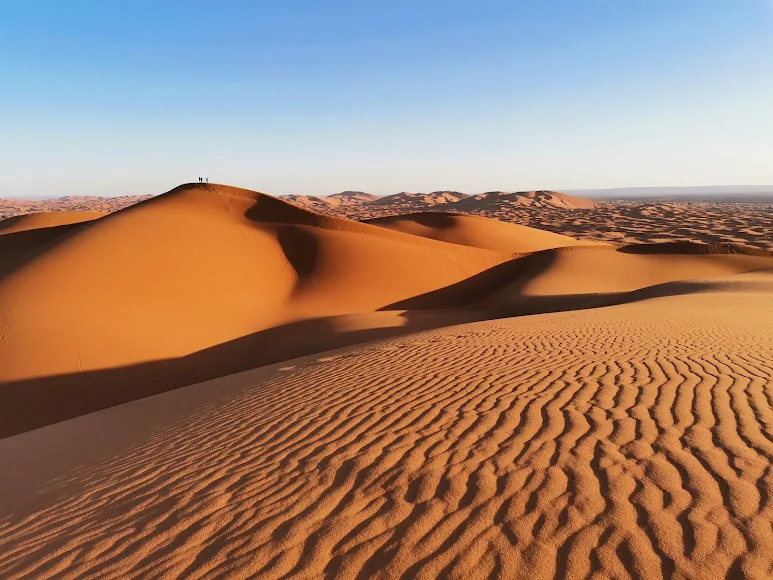
In the afternoon the landscape turns flat and mineral: we cross Erfoud and Rissani, the land of fossils and dates, and at last the dunes of the Erg Chebbi appear on the horizon. At Merzouga you leave the large bags behind and set off with a light backpack holding what you need for two nights, ready for the camel trek at sunset, about an hour across the dunes to our own Mouhou Camp. Moroccan dinner under the stars, Berber drums around the fire and a night in a tent, in the silence of the desert.
Day 4
Merzouga > Erg Chebbi > Khamlia > Merzouga:
This is the day that sets this itinerary apart: instead of driving off again, you stay in Merzouga and have a whole day for the desert. It starts with sunrise from the top of a dune, when the sand turns from grey to orange in a matter of minutes, followed by breakfast at the camp and the ride back to the village, where the minibus is waiting for the day's excursions. Your tents stay yours: the camp is also your base for the second night, so there is no need to repack.
The day is devoted to life around the Erg Chebbi: we visit the nomad families who live on the edge of the dunes, where you drink tea and see how the tent, the well and the goat herding work; we stop at the village of Khamlia, home to the descendants of sub-Saharan peoples, to hear gnawa music played live on krakeb and drums; we pass the seasonal lake of Dayet Srji, which attracts flamingos in spring, and the old kohl mines. Anyone who wishes can add a quad or 4×4 ride across the dunes locally. In the late afternoon we head back among the dunes for a second night at the camp, with a Moroccan dinner around the fire and breakfast included. Night in the desert camp at Merzouga.
Day 5
Merzouga > Rissani > Alnif > Draa Valley > Ouarzazate:
We say goodbye to the Sahara after breakfast at the camp: we ride back into Merzouga, collect the bags left in the vehicle and take the road back, but along a different, more southerly route than the one we came on. The first stop is Rissani, the ancient Sijilmassa of the trans-Saharan caravans: if it is a market day you walk through the donkey souk, one of the most authentic in Morocco, past mountains of dates and spices.
We continue to Alnif, a town known for its trilobite fossils, and then travel between the Jbel Saghro and the Draa Valley, a long corridor of palm groves and packed-earth kasbahs with the villages of Agdz and Nkob. Lunch is taken along the way, and we stop for photographs whenever the landscape deserves it. We cross the small Tizi n’Tinififft pass and arrive in Ouarzazate in the afternoon, with time for a walk in the centre or a look at the kasbah before the night in a hotel. It is a driving day, but the views change constantly.
Day 6
Ouarzazate > High Atlas > Marrakech:
A quiet and deliberately short day, so that you reach Marrakech with energy to spare. After breakfast we leave Ouarzazate and climb back into the High Atlas, retracing the Tizi n’Tichka pass in the opposite direction. The stops on the way up are different from those on the way out: the turning for the kasbah of Telouet, once the residence of Pasha El Glaoui, the mineral and pottery stalls at the roadside, and an argan oil cooperative run by Berber women, where you can see the fruit being cracked and ground by hand.
Beyond the pass the climate changes again: walnut trees, stone villages and the terraced fields of the northern slope appear. We arrive in Marrakech in the early afternoon and the group is dropped off at the hotel or riad. The rest of the day is free: you can rest, explore the streets around your hotel or treat yourself to a hammam, which after five days on the road is what we almost always recommend. Night in Marrakech.
Day 7
Marrakech: full day of sightseeing with a local guide:
This is the real finale of the trip. A licensed local guide spends the whole day showing you the red city, without the pressure of setting off for the desert the next morning. The morning is given over to the monuments: the minaret of the Koutoubia, the symbol of the city and the model for the Giralda in Seville; the Bahia Palace, with its courtyards, painted cedar ceilings and planted patios; the Saadian Tombs, rediscovered only in 1917; and the ruins of the El Badi palace, where storks nest.
In the afternoon we go into the medina: the souks organised by trade, from the dyers to the blacksmiths and the leather workers, the Ben Youssef Madrasa and the lanes of the tannery quarter. If you prefer greenery, you can ask the guide to include the Majorelle Garden and the Jardin Secret. The day ends at sunset in Jemaa el-Fna, among storytellers, snake charmers and food stalls: the best moment for dinner at leisure in the square or on a rooftop terrace. Last night in Marrakech.
Day 8
Marrakech > Marrakech airport:
After breakfast at the hotel the group tour comes to an end. Depending on your flight time, the driver collects you from your accommodation and takes you to Marrakech-Menara airport, only a few minutes from the centre; we recommend being at the check-in desk about two hours before departure.
If your flight leaves in the afternoon or evening, the morning is free and you can leave your luggage at the hotel: it is the ideal time to go back into the souks for whatever you spotted the day before, to linger over breakfast on a terrace facing the Koutoubia, or to have one last mint tea. If you would like to stay longer, you can add extra nights in Marrakech, a transfer to Essaouira or one of our camel excursions at a later date — just tell us when you book and we will arrange it alongside the group tour.
Book the 8-day group tour from Marrakech
The price of €660 per person is based on a double room, with fixed group departures on Tuesdays and Saturdays; it may vary according to the season and the single-room supplement.
Book nowNote: As this is a group tour with fixed dates, the stops and timings of the 8 days are the same for every participant and the itinerary is not altered.
Included
- Transfer from Marrakech airport on arrival and back to the airport on departure
- Pick-up and drop-off at your hotel or riad in Marrakech
- Air-conditioned minibus with an experienced local driver
- 5 nights in hotels and riads with breakfast
- Two nights in a desert camp at Merzouga with dinner, breakfast and Berber music
- Meals: two dinners at the desert camp and dinner in the Dades gorges
- Camel trek at sunset in Merzouga
- Licensed local guide for the Marrakech city visit
Not included
- Flights
- Lunches
- Drinks
- Entrance fees to monuments
- Tips
- Personal expenses
- Travel insurance
- Single-room supplement
Frequently asked questions
When does the tour depart and is there a minimum number of participants?
Departures are fixed every Tuesday and every Saturday, all year round. The tour runs with a minimum of 2 travellers, so in practice it almost always goes ahead. We recommend booking a few weeks in advance in high season, when the seats on the minibus fill up sooner.
How many people are in the group and who will I be travelling with?
The group is small, with a maximum of 17 travellers in the same minibus. It is usually an international group, with Italians as well as Spanish, French and other European travellers, and it includes couples, groups of friends and solo travellers of very different ages. The local driver stays with the group for all 8 days.
I am travelling on my own: can I join the group?
Yes, and a group tour is the format that suits solo travellers best. The price of €660 is based on a double room: if you would like a room to yourself the single supplement applies, otherwise we can try to pair you with another traveller of the same sex. On the nights in the camp the tents are separate in any case.
Where does the tour start and how does the airport transfer work?
The tour starts in Marrakech. We meet you at Marrakech-Menara airport on the first day with a sign showing your name and take you to your hotel or riad. On the second day the minibus collects the whole group from their accommodation in the city, and on the last day we drive you back to the airport in time for your flight.
What should I bring for the nights in the desert and how much luggage can I take?
Bring one suitcase per person plus a small backpack: the minibus has enough room, but not for oversized cases. For the desert you need light clothes during the day and a fleece or jacket for the evening, because the temperature drops after sunset even in summer. Add sunscreen, sunglasses, a scarf and a torch; large cases stay in the vehicle during the camel trek, so pack the backpack with what you need for the two nights at the camp.
Can children take part and how do I book?
Yes, children are welcome and those under 10 pay 5% less. A booking is confirmed with a 10% deposit and the balance is paid on arrival in Marrakech. If you are travelling with young children, bear in mind that days 2, 3 and 5 involve several hours in the minibus.
In August, do we really sleep two nights in the desert?
In August the temperatures in Erg Chebbi are very high and a sandstorm sometimes arrives. In that case we do not keep the group in tents but move the night to a hotel in Merzouga, and the rest of the programme carries on as planned.
What our travellers say
Excellent
Based on 64 reviews on Tripadvisor
Reviews of our 8-day tour from Marrakech are written by real travellers and verified by Tripadvisor. Read about their experiences on our private tours in Morocco.
Read all reviews